
You're probably paying for IT support and calling it security because that's how most vendors sell it. The tickets get answered, the laptops get patched, the Wi-Fi stays up, and nobody asks whether your backups would survive ransomware or whether your access controls would stand up to a real breach. That gap is exactly where cyber security consulting earns its keep, and it's why SMBs that can't justify enterprise retainers need a smarter buying model, not a bigger shopping list.
Table of Contents
- What Cyber Security Consulting Means
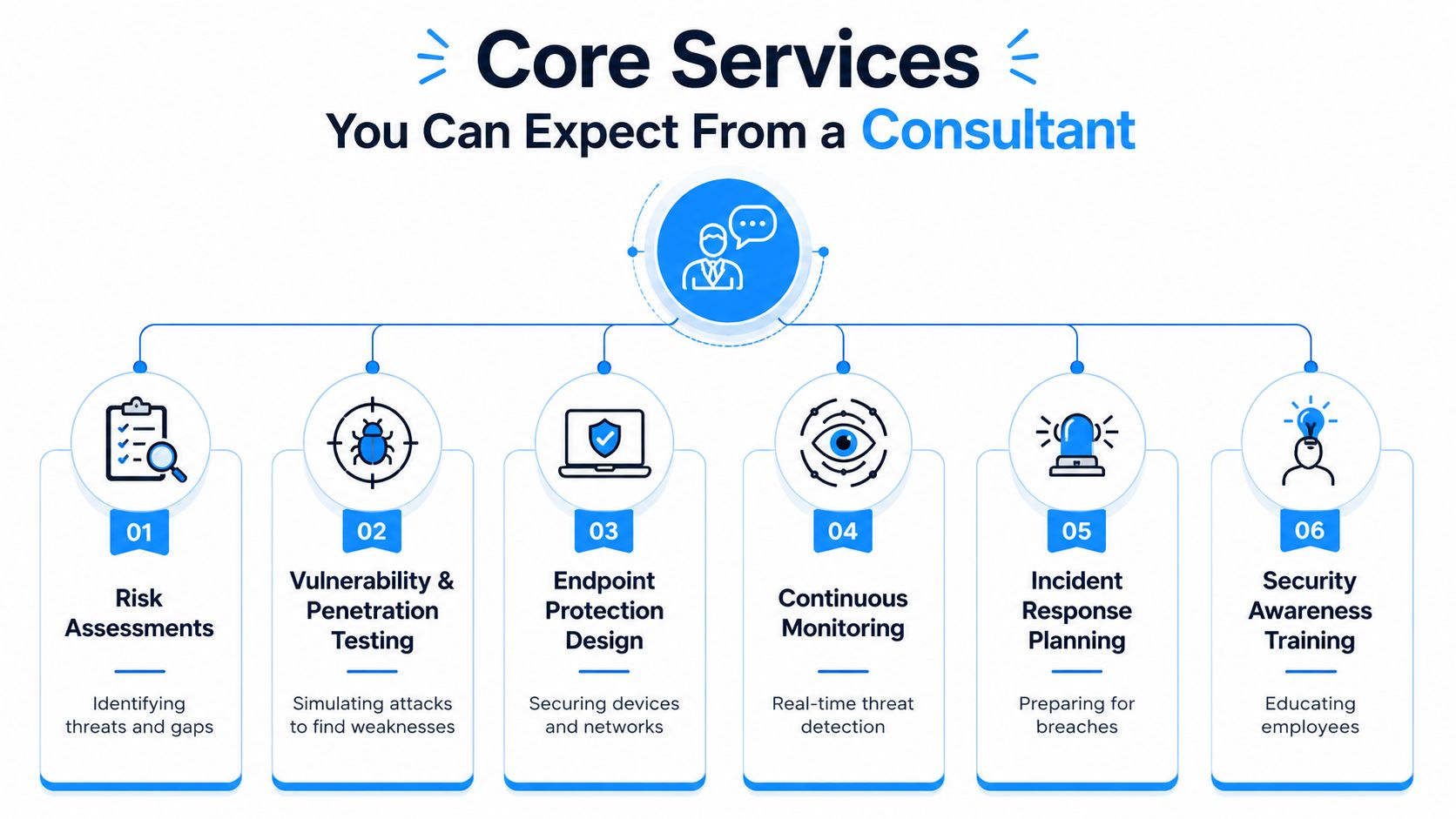
- Core Services You Can Expect From a Consultant
- Where the Consulting Budget Goes
- Why Small and Mid-Sized Businesses Need This
- Pricing Models and How to Think About ROI
- Red Flags and Questions to Ask Any Consultant
- Ottawa–Gatineau Compliance and Local Considerations
- Your Next Steps and 12-Month Action Plan
What Cyber Security Consulting Means
A business owner usually notices the gap between the IT guy et le security advisor after a scare. A phishing email gets through, a finance user approves a bad payment, or an insurer asks for evidence the team cannot produce. At that point, you do not need another generalist saying the server looks fine. You need someone who can show where the exposure sits and what to do about it.

The job is diagnosis, not decoration
A cyber security consultant assesses risk, designs controls, and verifies whether those controls work in practice. That is different from break-fix support, which keeps systems alive day to day. Market demand reflects that shift. Analysts at Mordor Intelligence estimate the global cyber security consulting market at USD 17.10 billion in 2025, rising to USD 20.34 billion in 2026 and USD 48.33 billion by 2031, with an implied 18.91% CAGR over 2026 to 2031, and they say risk assessment held 30.70% of market share in 2025 while network security held 23.80%.
That mix tells you something important. Canadian SMBs are not starting with exotic threat hunting. They are starting with the basics, what assets they have, where the gaps are, and whether the controls already in place are worth trusting.
The mechanic versus the engineer
Your MSP is the mechanic who keeps the car running. Your consultant is the engineer who checks whether the brakes, steering, and safety systems still hold up under stress. The mechanic may replace a worn part. The engineer tells you whether the whole design makes sense before the next hard stop.
Practical rule: If a vendor can only describe tools and tickets, you are talking to an operator. If they can map risk, prioritise remediation, and validate outcomes, you are talking to a consultant.
That distinction matters because accountability changes. A good consultant does not just recommend a product and disappear. They leave behind a risk register, a control plan, and a way to test whether the changes reduced exposure. For many SMBs, that means starting with a risk assessment, then sequencing controls around the business instead of buying a full stack on day one. If you need a place to begin, a structured network monitoring approach gives you the baseline you need before you spend on deeper consulting work.
Core Services You Can Expect From a Consultant
Most SMBs don't need every service at once. They need the right sequence. Start with understanding risk, then test weaknesses, then harden endpoints and networks, then monitor what's left, and only then lock in response and compliance work. Buying these services out of order usually wastes money.
Start with a risk assessment
A risk assessment is the health check-up. It inventories assets, maps likely threats, and shows where business processes depend on fragile controls. In a decent engagement, you get a clear risk register, not a vague opinion. That's the part most owners should insist on first, because the market data already shows it's where consulting spend concentrates (Mordor Intelligence).
Use testing to prove the weak points
Vulnerability testing and penetration testing are the stress test. One identifies flaws, the other simulates how an attacker might exploit them. A pen-test report should give you ranked findings, proof of exploitation paths, and remediation guidance. If you only get raw scan output, you're paying for noise.
Harden the environment that people actually use
Endpoint protection design is about the laptops, desktops, phones, and remote devices your staff use every day. This is the point where policy meets reality. The consultant should specify how devices are secured, what the baseline looks like, and how exceptions are handled without turning the whole environment into a mess.
Keep an eye on what happens next
Continuous monitoring is the smoke detector. It's not a silver bullet, but it gives you a chance to catch suspicious behaviour early. If you want a practical starting point for this layer, review how your monitoring stack and alert handling are currently organised, including the handoff between vendor and internal staff, through this guide to systems and network monitoring.
A consultant should also give you incident response planning and security awareness training. Those two get ignored until something breaks, then everyone scrambles. The deliverables should be an incident runbook and training materials your staff can use, not a slide deck nobody reads.
Where the Consulting Budget Goes
Owners usually ask about cost before they ask about scope. Fair enough. The trap is chasing the lowest bid and ending up with a thin engagement that produces a scan, a few slides, and no clear order of operations. For Canadian SMBs, the better buying model is staged work, priced to match the size of the environment and the amount of help you can use in the next 12 months.
The budget follows the foundation
The consulting market is not dominated by glamorous work. Risk assessment takes the biggest share of spending, with network security close behind and cloud security growing quickly, according to Mordor Intelligence. That matches what smaller firms need. Before you pay for advanced response services, you need a clean picture of what you own, how it connects, and which problems are worth fixing first.
Practical rule: If a consultant wants to sell response before mapping your assets and controls, they are jumping ahead of the work that reduces risk fastest.
How the spend usually lands
| Service Category | 2025 Market Share | Growth Signal |
|---|---|---|
| Risk Assessments | 30.70% | Largest share of spend, because buyers need baseline visibility first (Mordor Intelligence) |
| Network Security | 23.80% | Strong share, tied to core control design and segmentation work (Mordor Intelligence) |
| Sécurité cloud | Not stated | Forecast to grow at 19.85% CAGR as firms move more services and data off-premises (Mordor Intelligence) |
That split tells you where to start. Put the first wave of consulting dollars into visibility, control design, and the gaps that create the biggest exposure. A scan tells you where something is vulnerable. A risk assessment tells you whether that weakness touches payroll, client files, or day-to-day operations.
For an SMB buying on a budget, the right sequence matters more than the menu. Start with asset and account mapping, then baseline controls, then the testing and response work that depends on both. That is also where per-user and per-device pricing can help, because it forces the consultant to tie the scope to the actual workforce and the actual hardware instead of selling you an enterprise package you cannot use. Hold back long retainers and recurring dashboards until the basics are in place and someone on your side has time to act on the findings.
Why Small and Mid-Sized Businesses Need This
SMBs don't get a pass just because they're smaller. In practice, they're often easier to hit because defenders are leaner, systems are flatter, and one bad day can stall the whole business. The cost of a breach isn't just the incident. It's the interruption, the recovery, and the cleanup.
Canada's most common attack type changes the buying decision
In Canada, the Canadian Centre for Cyber Security says the most common type of cyber attack reported is ransomware, and it recommends layered controls, especially offline backups, phishing-resistant MFA, et rapid patching (Canadian Centre for Cyber Security guidance discussed here). That should shape what you buy first. If ransomware is the headline risk, then backup integrity, identity hardening, and patch timing deserve priority before you spend heavily on anything flashy.
The real-world pressure is different by sector
A dental clinic doesn't need abstract security theory. It needs to know whether patient records, consent forms, and notifications are handled properly under Law 25 and related privacy expectations. A law firm needs controlled access to client files, strong authentication, and a clean incident process because confidentiality failures are business failures. A retailer cares about point-of-sale resilience, staff access, and the ability to recover quickly after a compromise.
That's why consulting isn't a luxury. It's a way to buy judgement before you buy tools. The right advisor reduces panic spending, especially when the first incident tempts owners to throw products at the problem.
Why the first consultant engagement pays for itself
You don't need an enterprise security team to benefit from enterprise-grade thinking. You need a consultant who can prioritise controls in the order that matches your actual risks. For many SMBs, that means fewer tools, clearer ownership, and faster recovery when something goes wrong.
Pricing Models and How to Think About ROI
Owners usually get stuck. They know they need help, but they don't know whether they should pay by employee, by device, or by project. The right answer depends on what you're buying, how stable your environment is, and how much predictability you need in the budget.
Choose the model that matches the work
A per-user monthly retainer fits organisations that want predictable coverage across a stable staff base. It's easy to budget and works well when security needs are tied to people, access, and policy enforcement. A per-device model makes more sense in hardware-heavy environments, where every laptop, workstation, and shared terminal adds cost and risk.
A fixed-scope project fee is the cleanest option for a one-time assessment, audit, or compliance sprint. You pay for a defined outcome, not open-ended support. That's the model most SMBs should prefer for the first engagement, because you need facts before committing to a long relationship.
If you want a local pricing reference point, review IT Experts Canada's pricing guidance and compare it against the way your own environment is structured. Don't buy on the basis of headline monthly cost alone. Buy on the basis of what the vendor will deliver, how often they'll review it, and who owns remediation.
ROI is harder than vendors admit
McKinsey says one of the unresolved problems in cybersecurity is measurement of ROI, alongside the talent gap and technology fragmentation, and it argues for more full-stack, service-led models rather than fragmented product selling (McKinsey). That matches reality. Security is messy, and you usually won't prove value the way you prove revenue from a sales campaign.
Use practical proxies instead. Look for fewer incidents, shorter recovery times, cleaner audit files, and less scramble when a regulator, insurer, or client asks for evidence. If a consultant can't explain how their work changes those outcomes, the engagement is probably too vague.
Red Flags and Questions to Ask Any Consultant
A polished deck doesn't mean much. The best filter is a short list of blunt questions that force the consultant to show their working. If they dodge the answers, move on.
Ask for proof, not promises
- What certifications do your team hold? Ask for specifics, not branding. If they name credentials, that's fine. If they pivot to “experience” without evidence, that's a warning sign.
- Can you show a sample risk register or report? A serious consultant can show anonymised deliverables. If they can't, you're probably buying vague advice.
- How do you measure remediation effectiveness? You want to know how they check that fixes stuck, not just whether they were recommended.
- What does your incident response runbook look like? If the answer is just “we'll be there when something happens,” they're not really prepared.
Watch for the wrong sales behaviour
The worst red flag is a consultant who pushes products before the assessment is done. That's not advisory work, that's product placement. Another bad sign is vague language like “complete protection” or “full coverage”. Security doesn't work that way, and anyone selling it that way is overselling by design.
Accessibility matters too. If a consultant can't explain how their recommendations will work for multilingual staff, low digital literacy users, or teams with disabilities, they're leaving adoption on the table. Controls that people can't use consistently are controls that fail without notice.
A good consultant makes the hard parts usable. If they can't speak plainly about adoption, they're not ready for a real SMB environment.
Ottawa–Gatineau Compliance and Local Considerations
Local context changes the brief. A generic audit can tell you whether controls exist. It won't tell you whether those controls satisfy the obligations that matter in Ontario and Quebec, or whether the paperwork will stand up when someone asks for it after a breach.
PHIPA and Law 25 change the scope
Ontario's PHIPA and Quebec's Law 25 both raise the bar on access control, breach response, and accountability for personal information. That means a risk assessment for a healthcare or dental practice is not the same as a generic IT review. The consultant has to map data flows, classify regulated records, and test incident-notification workflows, because the question isn't only whether the system was attacked. It's whether the organisation can prove it handled personal information responsibly.
For organisations that need help aligning day-to-day operations with those obligations, this managed IT services overview shows why the operational side and the security side should work together rather than compete.
Local delivery matters more than people admit
Ottawa–Gatineau firms often operate bilingually, serve regulated clients, and face practical pressure to produce documentation fast. A consultant who understands the regional environment can move faster when an incident escalates, because they know what evidence the client will need and how the reporting chain usually works. That saves time, but it also reduces confusion when the business is already under stress.
Healthcare, dental, legal, and accounting firms in the region should treat compliance readiness as part of the security engagement, not as a separate afterthought. If the consultant treats privacy, response, and access control as one conversation, the final plan is usually stronger and easier to maintain.
Your Next Steps and 12-Month Action Plan
Don't buy everything at once. Start with a clean sequence and make the consultant prove value at each stage.
A practical roadmap
- Days 1 to 30, scope and select. Choose a consultant or a hybrid MSP and consultant model, and define the environment they'll assess.
- Days 31 to 90, assess and fix the obvious gaps. Run the initial risk assessment, verify backups, tighten MFA, and patch the highest-risk systems.
- Months 4 to 6, harden and monitor. Expand endpoint controls, tune monitoring, and lock down the handoff process for alerts and remediation.
- Months 7 to 12, document and test. Build incident response workflows, prepare compliance evidence, and exercise the plan so people know their roles.
If you already have an MSP, keep them focused on daily operations while the consultant validates risk and sequencing. If you don't, use a hybrid model. It's usually the cleanest fit for SMBs with limited internal IT staff.
Choose standalone consulting when you need a one-time assessment or compliance push. Extend MSP coverage when day-to-day operations are the pain point. Use a hybrid model when you need both operational support and independent security judgement. If you want help sorting that out for your own environment, contact IT Experts Canada and ask for a focused review of where consulting, monitoring, and managed support should start in your business.
0 Comments