
You're probably looking at a stack of issues that all feel urgent at once, a firewall renewal, a phishing scare, a client asking about security, and a nagging sense that your network hasn't been properly tested in years. That's exactly where penetration testing services earn their keep. They show you what a real attacker could do before a real attacker does it, which is a very different thing from hoping your tools are enough.
Table of Contents
- What Penetration Testing Is and Why Your Business Needs It
- Common Types of Penetration Tests Explained
- The Professional Penetration Testing Lifecycle
- Making Sense of the Results and Taking Action
- Meeting Canadian Compliance with Penetration Testing
- How to Select the Right Penetration Testing Provider
- Frequently Asked Questions About Penetration Testing
What Penetration Testing Is and Why Your Business Needs It
Think of a penetration test like hiring an ethical burglar to try your doors, windows, alarm system, and office routines. A good tester doesn't just jiggle handles, they look for the easy mistake that lets them move from one weak spot to another. That's why penetration testing is not the same thing as a basic scan, and why business owners in Ottawa-Gatineau should treat it as a practical risk check, not a technical luxury.
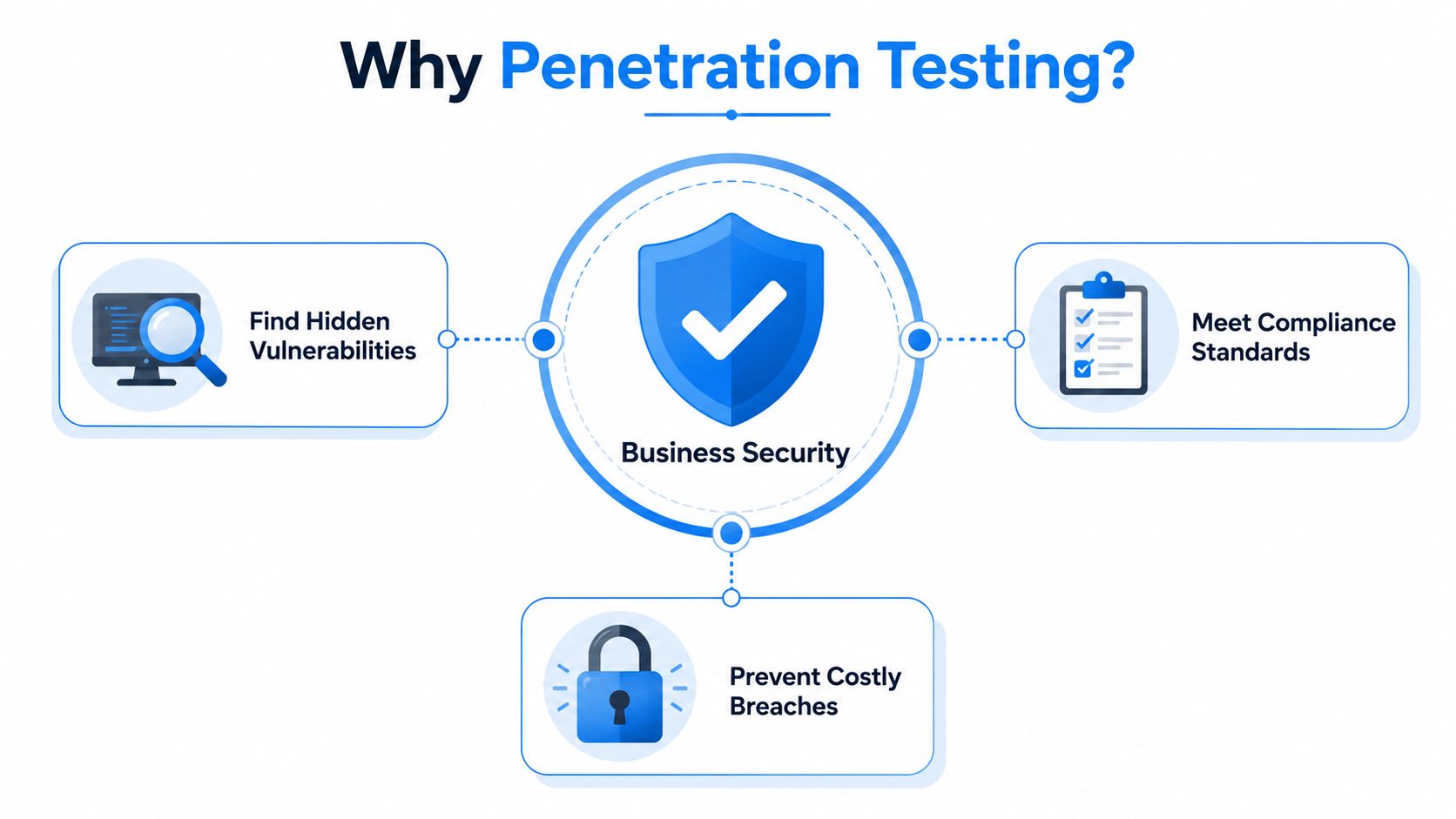
A scan tells you what's visible. A pen test shows you what can be used. The distinction matters because 68% of breached organisations had not performed a penetration test in the year before the incident, and organisations that conduct quarterly pen tests saw 53% lower breach rates than those testing annually or less often, according to the data cited by ZeroThreat's summary of industry statistics. That same source also says attackers can penetrate a local network in about 4 days, et 73% of successful business-sector breaches involved exploited web-application vulnerabilities, which is a blunt reminder that waiting for an annual review is a weak strategy (ZeroThreat penetration testing statistics).
Practical rule: if your business handles customer data, payment flows, client files, or remote access, you need human testing, not just automated reassurance.
That's especially true for SMBs that rely on cloud apps, remote work, and third-party platforms. Automated tooling can flag obvious issues, but a real tester can chain small weaknesses together, prove lateral movement, and translate a technical flaw into business impact. That difference is what turns a vague security concern into a clear decision about whether to fix, isolate, or reconfigure a system.
For Ottawa-Gatineau firms, the point is simple. If a flaw could expose client records, interrupt billing, or undermine a bid for a regulated contract, it's not “an IT issue”. It's a business continuity issue, and it deserves a proper penetration testing service scope, not a one-off scan.
Use the test as part of a broader assessment of your environment, not a substitute for it. If you're still mapping your infrastructure, this free IT infrastructure analysis is a sensible place to start before you pay for offensive testing.
Common Types of Penetration Tests Explained
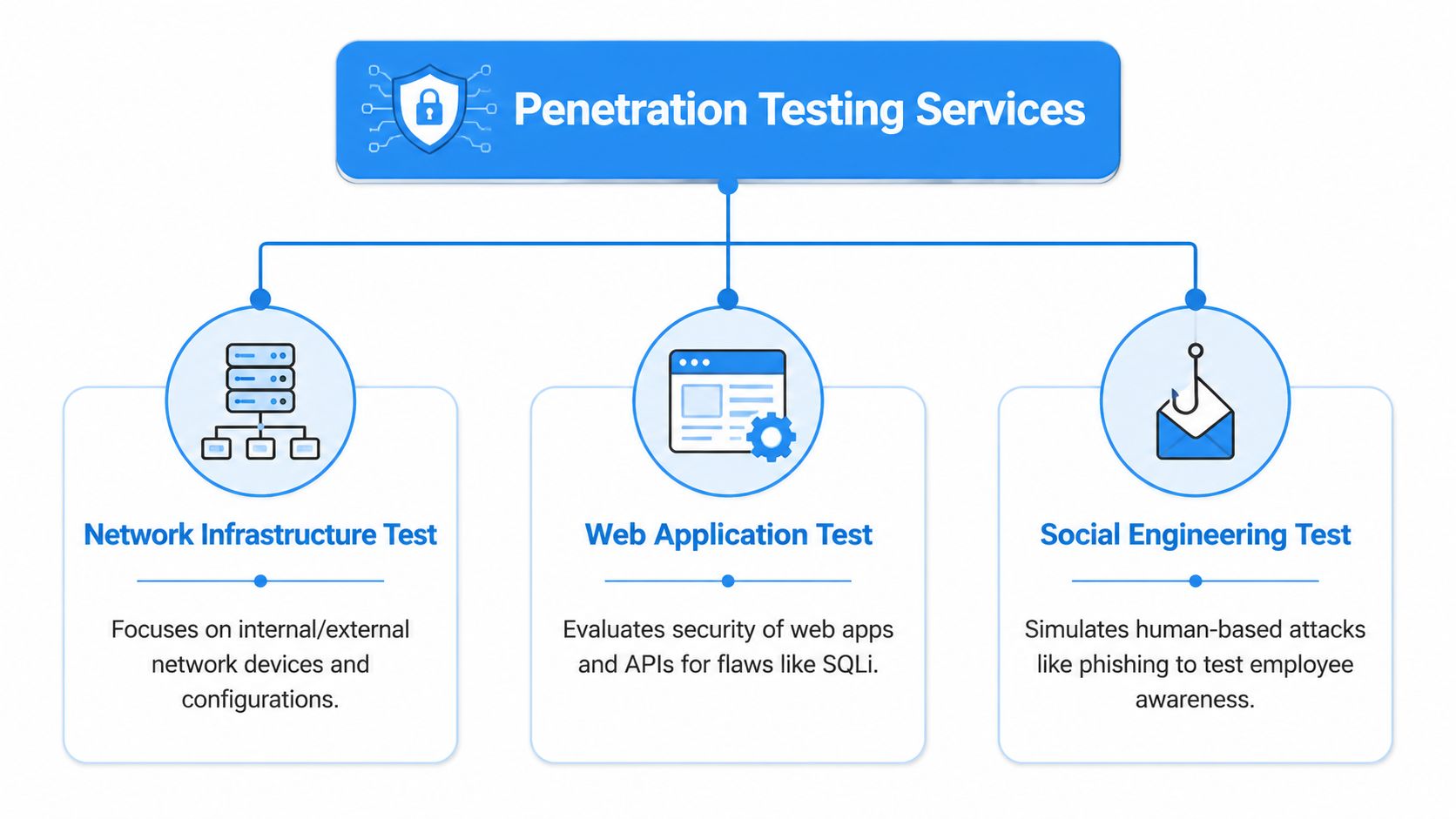
Different attack surfaces need different tests. A provider that pushes one generic package for every business is usually oversimplifying the risk. For Ottawa-Gatineau buyers, the best move is to scope the test around the asset that would hurt most if compromised, whether that is the public internet, an internal endpoint, a web app, or a staff member who clicks the wrong link.
External network testing
External testing fits businesses that need to know what an unauthenticated attacker can reach from outside. That matters for multi-site service firms, retail chains, and any Ottawa business with exposed VPNs, web portals, or remote access systems. The focus is perimeter exposure, not internal blast radius, so the question is whether a stranger on the internet can get a foothold.
Internal network testing
Internal testing assumes someone already has network access, maybe through a compromised laptop, a rogue device, or an insider account. That makes it especially relevant for law firms, healthcare clinics, accounting practices, and any business storing sensitive records on shared systems. A good internal test checks how far an attacker could move once inside, and whether privilege boundaries hold.
Web application testing
If your business takes bookings, processes payments, hosts client portals, or exposes internal workflows through a browser, web app testing should be high on the list. Ottawa e-commerce teams, ByWard Market retailers, and SaaS companies all depend on this surface. The point is not to “test the website”, it is to see whether business logic, authentication, session handling, and data access controls can be bent or bypassed.
Social engineering and red teaming
Social engineering testing looks at people, not just systems. It checks whether staff can be tricked into opening the door for an attacker, and it works well when your business depends on email, remote support, or high-trust client communication. Red teaming goes further, combining multiple attack paths to simulate a more determined adversary, and it belongs with mature organisations that already know their core controls are in place.
Short version: choose the test based on the most realistic path into your business, not the most impressive brochure language.
The delivery window also changes by test type. A penetration testing service guide breaks common engagement windows into 1 to 3 weeks for network tests, 2 to 4 weeks for web applications, and 4 to 8 weeks for red-team style adversary simulation. That tells you something important, deeper attack-path validation takes time and costs more. That is not bloat, it is what happens when testers manually prove how the weak point behaves in practice.
For Ottawa-Gatineau buyers, the best move is to scope the test around the asset that would hurt most if compromised. If the crown jewel is a client portal, test the portal. If the pain point is internal file access, test the internal network. If the pain point is staff manipulation, test human exposure.
The Professional Penetration Testing Lifecycle
A proper engagement should feel controlled, not chaotic. The client should know what's in scope, who's testing, what methods are allowed, and how the provider will avoid disrupting business operations. IBM describes penetration testing as a mock cyberattack against apps, networks, or other assets, and says the scope must define which systems are tested, when the test will occur, and what methods are allowed (IBM penetration testing overview).
Scoping comes first
Scoping is where most bad engagements are either prevented or created. If you skip this part, you invite confusion about systems, testing windows, and acceptable tactics. The best providers will ask about production versus non-production systems, business-critical hours, third-party dependencies, and any tools that could trigger alerts or downtime.
A useful scoping conversation should also define the attack model. As Red Fox Security notes, external testing should emulate an unauthenticated internet attacker, while internal testing should assume a compromised endpoint or insider access, because that initial access model changes what the test is really measuring (Red Fox Security scoping guidance).
Testing, reporting, and follow-up
The UK National Cyber Security Centre breaks a typical test into five stages, initial engagement, scoping, testing, reporting, and follow-up, which is still the cleanest way to think about the lifecycle (NCSC penetration testing guidance). In the testing phase, the provider should use hands-on techniques, not just run tools and paste the output into a PDF. A service guide from Warren Averett describes the familiar flow, define scope and goals, gather public information, scan for weaknesses, attempt access, maintain access if successful, then produce a detailed report that supports remediation decisions (Warren Averett overview).
You should expect the provider to clean up after itself. IBM specifically calls out cleanup and reporting, including removal of planted back doors or configuration changes after the test ends (IBM penetration testing overview).
The test should leave you with evidence, not leftovers.
For Ottawa-Gatineau SMBs, that process matters because many environments are too busy for ad hoc disruption. You want the tester to be aggressive where appropriate and disciplined everywhere else. If the provider can't explain their rules of engagement in plain English, keep looking.
Making Sense of the Results and Taking Action
A penetration test report is only useful if your team can act on it. Too many reports are just long lists of findings with no business context, no proof, and no clear sense of what to fix first. A good report should help you decide where to spend time, where to accept risk, and what needs immediate remediation.
Demand evidence, not noise
Red Fox Security's scoping and deliverable guidance is useful here too, because mature pentest reports should include severity distribution, reproducible evidence, and retesting results so teams can verify closure of critical findings rather than just documenting them (Red Fox Security deliverable guidance). That means screenshots, steps to reproduce, affected systems, and a clear explanation of business impact. If a report only says “high risk found” and leaves your IT team guessing, it's not a strong deliverable.
You should also expect a clean executive summary. Senior leaders don't need packet details, they need to know whether the issue could expose client data, interrupt operations, or create compliance problems. That summary should be readable without a security background, because the people approving remediation budgets often aren't engineers.
Retesting is part of the job
Retesting matters because a fix that looks good in a ticket can still fail in practice. A provider that offers retesting gives you confirmation that the issue is fully closed, not just marked complete. That's the difference between security work and paperwork.
If your MSP or internal team is going to remediate the findings, the report should be structured so they can work from it directly. That includes enough technical detail to reproduce the issue, but also enough prioritisation to avoid wasting a week on low-value cleanup while the critical path stays open. A weak report creates churn. A strong report shortens the fix cycle.
A real decision-maker reads the report and answers three questions fast, what can be exploited, what would it cost the business, and what gets fixed first. If those answers aren't obvious, the report hasn't done its job.
For businesses already using a monitoring stack, the findings should feed into broader visibility work, not sit in isolation. If you're building that operational view, this systems and network monitoring work is where pentest remediation often becomes a permanent control rather than a one-time cleanup.
Meeting Canadian Compliance with Penetration Testing
Canadian businesses don't need a national law that specifically says “do a penetration test” to make testing important. They need evidence that they took reasonable steps to protect data, respond to risk, and maintain security controls. That's where penetration testing services become a compliance asset, not just a technical exercise.
PHIPA, PIPEDA, and the practical standard
If you handle personal information, you're already dealing with expectations around safeguards, breach readiness, and data stewardship. In Ontario healthcare and allied health settings, PHIPA raises the bar for protecting personal health information. For commercial organisations, PIPEDA and related privacy obligations push the same basic principle, collect and store data responsibly, then prove you're not guessing about security.
The useful point is this, a penetration test helps show that your controls were checked by a human attacker model, not just assumed to be working. That matters when an auditor, customer, insurer, or procurement team asks what you do beyond policy documents and antivirus licences. It's a concrete piece of evidence that the business did something proactive.
The U.S. CISA penetration testing page also reflects the broader industry view that penetration testing is part of an ongoing security programme, with risk-based controls and testing used to support security assurance rather than replace it (CISA penetration testing guidance). That aligns well with how Canadian SMBs should think about it, as one control inside a bigger, documented programme.
Why documentation matters in Ontario and Quebec workflows
Ottawa-Gatineau firms often cross provincial and sector boundaries. A clinic may need privacy discipline under healthcare rules, while a professional services firm may need strong handling of client records under commercial privacy expectations. In both cases, the report itself is only half the story. The remediation record, re-test confirmation, and internal sign-off are what make the effort useful later.
Keep the report, the remediation tickets, and the retest outcome together. Auditors hate scavenger hunts.
That's also why procurement teams increasingly care about testing artefacts. If you're bidding for work with government, healthcare, or enterprise clients, they may ask whether your security programme includes offensive testing, how issues are tracked, and whether critical findings were verified closed. A clean report helps. A report plus closed-loop remediation helps more.
The Canadian Centre for Cyber Security continues to warn that ransomware remains a top threat to Canadian organisations, which makes documentation of testing and remediation more operationally valuable than a one-time report. When threat pressure is high, you want proof that your team didn't just identify risk, they reduced it.
For Ottawa-Gatineau SMBs, the bottom line is direct. If you process sensitive data, a pentest report with evidence, remediation, and retesting can support privacy diligence, procurement conversations, and cyber insurance reviews. It won't make you instantly compliant, but it gives you something real to show when someone asks how you know your controls work.
How to Select the Right Penetration Testing Provider
Choosing a provider is a risk decision, not a shopping exercise. A cheap quote with thin methodology can cost more later if the findings are vague, the scope is wrong, or the report can't support remediation. On the other hand, a large brand name doesn't automatically mean the best fit for a small Ottawa-Gatineau business with a focused attack surface.

Ask the questions that expose quality
Start with methodology. Ask how much of the test is manual, what tools are used, how the provider validates exploitability, and whether the report includes reproducible evidence. Then ask for a sample deliverable. If the sample report reads like a scanner dump, the engagement probably will too.
You should also ask about retesting, reporting format, and who does the work. A provider that hides tester experience behind sales language is making you buy blind. If they can't explain how they'll handle your specific environment, they're not ready for your environment.
Look for local fit and operational continuity
For Ottawa-Gatineau SMBs, local knowledge matters more than most vendors admit. A provider that understands Canadian business cycles, regional compliance expectations, bilingual environments, and the realities of small IT teams can scope better and communicate faster. That doesn't mean global firms are wrong, it means the best provider is the one that can work with your cadence and your obligations.
If you already have an MSP or a managed security relationship, the cleanest setup is often one where testing results feed directly into ongoing monitoring, patching, and hardening. That way, the pentest isn't a stand-alone report that gets filed away, it becomes part of a continuous security programme. A provider should be able to fit into that workflow instead of forcing you to build a parallel process just to manage one engagement.
Use the fit test, not the sales pitch
A good provider makes the risk easier to see. A weak provider makes the paperwork easier to ignore.
The practical filter is simple. Choose the team that can show manual depth, clear evidence, real follow-up, and a reporting style your internal people can use. If you need a broader security relationship around the test, this security solutions resource is the kind of conversation starter that helps connect offensive testing with day-to-day protection.
Frequently Asked Questions About Penetration Testing
How often should an SMB do a pen test?
Quarterly is the strongest cadence cited in the data you can rely on here, because organisations doing quarterly pen tests saw 53% lower breach rates than those testing annually or less often (ZeroThreat penetration testing statistics). That doesn't mean every SMB must test every quarter, but it does mean annual-only testing is weak if your environment changes often. New apps, new integrations, new remote access tools, and new staff workflows all expand the attack surface.
If quarterly is too aggressive for your budget, test after major change, after a new system launch, after a merger, or before a regulated procurement cycle. The worst plan is to treat a pentest as a once-a-decade checkbox.
What should a reasonable quote include?
A useful quote should spell out scope, method, time window, deliverables, and retesting. It should also make clear whether the work is manual, automated, or both. IBM's guidance on scope is relevant here, because the provider should define what systems are tested, when the test happens, and what methods are allowed (IBM penetration testing overview).
Pricing varies widely by scope and complexity. Planning ranges in the market can be small web tests, standard web tests, APIs, mobile apps, external and internal networks, cloud environments, product assessments, and red teaming, but the right quote is the one that matches your actual business exposure. If a provider can't explain why the price changed when scope changed, they probably didn't scope properly.
Is a vulnerability scan enough?
No. A vulnerability assessment relies on software scanning, while a pen test uses hands-on exploitation attempts to show actual impact. That difference matters because a scan may tell you something is present, but a pen test shows whether it can be used to reach data, pivot to another system, or weaken controls. Warren Averett's service overview makes that distinction clearly, and it's one buyers should keep in mind when comparing quotes (Warren Averett overview).
For small businesses, the scan-versus-test difference is where many buying mistakes happen. A scan is useful. It is not a substitute for proving real-world exploitability.
What proof should you keep after the test?
Keep the report, the remediation tickets, the retest outcome, and any executive sign-off together. That package helps with auditors, insurers, and vendor due diligence. Red Fox Security's deliverable guidance is useful here because mature reports should include reproducible evidence and retesting results, not just a list of issues (Red Fox Security deliverable guidance).
For Ottawa-Gatineau businesses, that documentation is worth more than the PDF itself. It shows that the issue was found, assigned, fixed, and checked.
What's the biggest mistake buyers make?
They buy the cheapest test and expect the richest insight. That rarely works. Low-cost engagements often mean shallow manual work, generic reporting, and little remediation support, while the most expensive quote isn't automatically the best either.
The right question is not “What's the cheapest pentest?” It's “Which provider can show me the actual path into my environment, explain the risk in business terms, and help my team close the gap?” That's the standard worth paying for.
IT Experts Canada helps Ottawa-Gatineau SMBs turn security from a one-time project into an operational habit, with managed IT, monitoring, and practical cybersecurity support that fits real business workloads. If you're ready to pair penetration testing with ongoing protection and clear remediation, visit IT Experts Canada and start a conversation about the systems you want to harden next.
0 Comments