

A server alert hits at 8:10 a.m., Microsoft 365 access is spotty, and your team cannot tell whether the problem is local, cloud-related, or a security issue. In that moment, the quality of your IT partner shows up fast. Response time matters, but so do escalation paths, documentation, backup testing, and the provider's ability to explain business impact without hiding behind technical jargon.
Ottawa gives buyers plenty of options. That is good for competition, but it also makes weak providers easier to mistake for capable ones. Similar service pages, similar promises, similar tool stacks. The difference usually shows up later, during an outage, a migration, an audit, or a renewal discussion where pricing and scope suddenly stop matching the sales pitch.
From an Ottawa IT provider's perspective, the right evaluation process is more useful than a long list of names. Business owners usually need help comparing operating model, support coverage, security maturity, project discipline, and whether a firm can support growth. If you are weighing outsourced support or a managed IT services partner in Ottawa, ask direct questions early: Who answers after hours? What is excluded from the monthly fee? How often are backups tested? Who owns vendor coordination? What happens if your primary technician leaves?
Red flags are usually practical, not dramatic. Vague onboarding. No clear remediation process. Reporting that lists ticket counts but says nothing about recurring risk, user friction, or aging hardware. A good technology company should connect technical decisions to uptime, cost control, compliance requirements, and the workload on your internal team.
This guide compares notable Ottawa technology companies through that lens, so you can screen providers with more discipline and avoid an expensive mismatch.
Table of Contents
- 1. IT Experts Canada
- 2. Revolution Networks
- 3. Bedrock IT
- 4. Compulite
- 5. Stega Networks
- 6. NCDS Canada Inc.
- 7. GAM Tech Ottawa
- Ottawa Technology Companies, 7-Way Comparison
- How to Choose Your Ideal Ottawa Tech Partner
1. IT Experts Canada

A common Ottawa scenario goes like this. A business owner is juggling Microsoft 365 issues, inconsistent backups, staff security questions, and a renewal coming up on internet or phone services. At that point, a provider with a clear operating model matters more than a long service menu.
IT Experts Canada fits that practical buyer profile. Its offering covers managed IT support, cybersecurity, cloud services, backup and disaster recovery, and telecom advisory work. For small and mid-sized organisations, that can reduce the number of vendors involved in day-to-day operations and make accountability easier to pin down when something breaks.
Why it stands out
The main strength here is service coverage that lines up with how many Ottawa businesses buy IT. One team can support users, monitor systems, manage endpoint protection, maintain firewalls, handle backups, and assist with productivity platform changes. If your business is considering Microsoft 365, hosted environments, or a broader cloud transition, their business cloud solutions and migration services are part of the evaluation.
That matters because handoffs create risk. When one vendor manages support, another handles security, and a third owns backups, problems often sit in the gaps between contracts. A single provider does not solve every issue, but it usually gives leadership one place to push for answers, timelines, and remediation.
There is also a useful commercial detail here. The company presents an initial analysis and public guidance around common pricing models. For an owner trying to compare Ottawa technology companies without sitting through three vague sales calls, that makes early budgeting easier.
Practical rule: Ask a provider to walk you through a real restore, a Microsoft 365 rollback scenario, and an after-hours escalation path before you sign. If the explanation is fuzzy in the sales process, service delivery usually follows the same pattern.
The bilingual angle is also relevant in Ottawa. Rather than relying on a weakly sourced percentage, the more useful point is operational. If your leadership team, front-line staff, or client-facing documentation span English and French, confirm how tickets, onboarding, user communication, and documentation are handled in both languages.
Where to press for detail
Disciplined buyers should slow down and verify. The public material explains the service model clearly, but it does not put heavy emphasis on third-party validation, public certifications, or a deep library of case studies. That is not a deal-breaker. It means the buying process should include sharper questions.
Start with fit. Ask for references from organisations close to your size and industry. If you operate in legal, healthcare, financial services, or another regulated setting, ask for examples of how controls are documented, reviewed, and reported.
Then move to operations. Who owns incident coordination during ransomware containment? How often are restores tested? What is included in the base agreement, and what triggers project fees? Ottawa businesses often miss this step, then discover too late that onboarding, policy work, or compliance reporting sits outside the monthly contract.
A few practical takeaways:
- Wide service coverage: Managed IT, security, cloud, backup, and telecom support can reduce vendor sprawl.
- Clearer early budgeting: Upfront analysis and visible pricing guidance help buyers compare options faster.
- Good local fit: Ottawa-Gatineau presence and bilingual service can matter for internal adoption.
- Main watch point: If your business needs audit-ready compliance evidence, request sample documentation before procurement is complete.
For buyers who want a structured, operations-focused MSP and are willing to verify the details, IT Experts Canada deserves a place on the shortlist.
2. Revolution Networks
Revolution Networks is the kind of provider that appeals to businesses looking for one team to handle both steady-state IT support and infrastructure projects. It combines managed services, help desk work, IT consulting, remote backup, and network cabling. That's a practical mix for firms moving offices, opening locations, or trying to bring order to years of piecemeal decisions.
Its appeal is straightforward. Some MSPs are strong at support but weak when physical infrastructure work enters the picture. Revolution Networks looks better suited to organisations that need both service continuity and hands-on project execution.
Best fit
This provider makes the most sense when your business is beyond basic break-fix but not yet large enough to build specialist internal IT functions. If you need a roadmap, equipment planning, user support, and cabling handled by one vendor, the service catalogue is attractive.
That said, buyers should separate breadth from maturity. A broad list of services is useful, but it doesn't automatically tell you how thoroughly they manage security governance, reporting, or regulated environments. That's the same reason many Ottawa businesses compare firms like Revolution Networks against more structured managed IT services in Ottawa before committing.
A provider that can wire an office well isn't automatically the provider that should own your security controls.
The main limitation is commercial transparency. Pricing isn't standardised publicly, and advanced compliance attestations aren't prominently displayed online. If your organisation is in legal, healthcare, defence-adjacent work, or another regulated setting, ask for examples of how they handle onboarding, access control, retention, and incident escalation before you focus on the monthly number.
Revolution Networks is a solid shortlist candidate for businesses that value local presence and one-vendor convenience. Just make sure the proposal shows process depth, not just service breadth.
3. Bedrock IT

Bedrock IT positions itself around reliability. That sounds generic until you look at what smaller Ottawa businesses struggle with: inconsistent support, noisy alerts with no action behind them, and Microsoft 365 environments that grow messy because nobody owns standards.
Bedrock's emphasis on 24/7 monitoring, managed desktops and servers, Microsoft 365 support, and outage reduction speaks directly to those pain points. For a lean team, that operational focus can be more valuable than a longer list of secondary services.
A lot of buyers in the technology companies Ottawa market overvalue “strategy” and undervalue baseline discipline. If the MSP can't keep endpoints patched, standardise configurations, and resolve recurring issues cleanly, the roadmap deck won't matter.
What to verify before signing
The fit is strongest for SMBs that want a provider centred on uptime and routine support rather than a large consulting layer. If your day-to-day problems include workstation inconsistency, mailbox issues, shared file sprawl, and recurring infrastructure alerts, Bedrock's service profile is sensible.
Its online materials don't publish pricing, so expect a discovery-led sales process. That isn't unusual, but it does mean you should control the conversation. Ask what is included in monitoring, what triggers human intervention, and whether Microsoft 365 hardening is part of core service or treated as project work.
Cloud conversations are another place to push for specifics. If a provider mentions Microsoft 365, ask whether they also support migration design, identity cleanup, backup planning, and remote desktop options similar to broader cloud solutions for Ottawa businesses.
- Good fit: Smaller organisations that need strong operational oversight and dependable user support.
- Potential drawback: Limited public detail on security attestations and no listed pricing.
- Best buyer move: Ask for a sample onboarding plan and a sample monthly report before you sign.
Bedrock IT looks practical and Ottawa-focused. The key decision comes down to how much structure sits behind the uptime message.
4. Compulite

A common Ottawa buying scenario looks like this. The business has grown past informal IT support, leadership is worried about security exposure, and nobody wants to hand a sensitive environment to a provider that improvises as it goes. Compulite fits that conversation well because its positioning is built around continuity, managed service discipline, and security-aware operations.
That profile tends to matter more in Ottawa than in many other cities. The local market includes a high concentration of public sector work, regulated organisations, and firms that deal with confidential client or operational data. Buyers in those settings usually need a provider that can document changes, control access, and connect day-to-day support with policy and project delivery.
Where Compulite can make sense
Compulite is a stronger candidate for organisations that want one team to handle support, planned improvements, and security oversight in a coordinated way. If your internal staff is small, that operating model reduces handoff risk. It also makes accountability easier to pin down when something slips.
Security buyers should go beyond the headline message and ask what is included in service. Request specifics on patching standards, Microsoft 365 protections, endpoint controls, backup testing, and response procedures. If those areas are a current concern, compare the proposal against the kind of coverage businesses usually expect from managed cybersecurity services for Ottawa organisations.
The trade-off is management style. A provider built around process often suits companies that need consistency, audit trails, and fewer surprises. The same structure can feel slow to owners who are used to texting a technician for one-off requests and getting an informal fix.
Use that trade-off as a filter. Ask how changes are approved, how after-hours issues are handled, who owns documentation, and what the first 90 days look like after onboarding.
If your business handles regulated data or works with government-adjacent clients, ask Compulite to show you a sample change record, escalation path, and security review process. Those documents tell you more than a sales pitch will.
Compulite is a sensible option for buyers who want an established Ottawa provider with a formal service model. The right decision depends less on brand recognition and more on whether that structure matches how your business wants IT decisions made, documented, and enforced.
5. Stega Networks

A common Ottawa scenario looks like this: the business wants better cloud performance and tighter support, but the pain still starts in the server room, wiring closet, or aging network stack. Stega Networks stands out for companies in that position because its service mix spans managed IT, infrastructure design, cloud projects, and backup and disaster recovery.
That matters when modernisation has to happen in phases. Many providers are comfortable supporting users after the environment is stable. Fewer are equally comfortable dealing with switching, cabling, on-site infrastructure, and the operational disruption that comes with changing those layers while the business is still open.
Evaluating the fit
Stega looks strongest for organisations where physical infrastructure still shapes business outcomes. Offices with older network layouts, clinics with uptime concerns, and multi-unit facilities often need more than a help desk contract. They need a provider that can improve the foundation without creating unnecessary downtime.
The main evaluation point is visibility. Stega's public materials show a broad service range, but they give less detail than some buyers will want around SLA commitments, escalation rules, and what is included versus billable project work. That does not make them a poor choice. It means the buying process needs to be more disciplined.
This is also where Ottawa buyers should keep priorities in order. Statistics Canada has reported that AI use is still concentrated among a relatively small share of Canadian businesses, especially compared with the volume of market discussion around adoption. If a provider leads with innovation language, ask how they secure identities, protect Microsoft 365, test backups, and handle incident response before new tools are added.
Use Stega as a fit test, not just a name on a list. Ask who owns the network diagram, how backup restores are validated, whether after-hours response is handled by an internal team or handed off, and what a first infrastructure assessment includes.
- Strong angle: Good fit for businesses that need both hands-on infrastructure work and ongoing managed support.
- Watch point: Limited public detail on service guarantees and support boundaries.
- Best use case: Organisations upgrading networks or core systems in stages while keeping daily operations stable.
Stega Networks makes the most sense when your IT partner needs to understand the cable path and the cloud roadmap, not just the ticket queue.
6. NCDS Canada Inc.

NCDS Canada Inc. appears aimed at a part of the Ottawa market that is often underserved. Small businesses need dependable support, clear standards for devices and users, and fast answers when something breaks. They usually do not need an oversized stack of niche services. They need order.
That positioning matters because smaller organisations often reach a point where informal IT stops working. The owner is still approving laptop purchases, staff are sharing admin access, and onboarding depends on whoever remembers the last setup. A provider that brings structure to those basics can remove a surprising amount of operational drag.
NCDS's messaging points to managed services, a free initial IT assessment, and practical controls around the user environment. For the right client, that is a sensible offer. Standardising endpoints, email signatures, access rules, and support workflows will not impress a procurement committee, but it does reduce avoidable tickets and inconsistent setups.
Questions worth asking
Buyers need to be specific. A small-business-friendly MSP can be a strong fit, but only if the service boundaries are clear enough to support growth.
Ask what the free assessment produces. A useful assessment should give you a prioritised list of risks, a rough remediation path, and a clear explanation of what moves into monthly support versus project billing. If it ends with broad advice and no ownership model, the sales process is still doing too much of the work.
Ask about security depth too. Many Ottawa businesses want approachable support, but approachable is not the same as mature. Confirm how NCDS handles Microsoft 365 security, endpoint protection, admin privilege control, backup monitoring, and incident escalation. If your business has compliance pressure from clients or insurers, ask that question early rather than after the agreement is signed.
Documentation is another pressure test. Smaller clients sometimes tolerate weak records because the provider is easy to reach. That trade-off usually becomes expensive later. You want current asset lists, named admin ownership, documented onboarding and offboarding steps, and a recovery process that can be followed by someone other than the technician who built it.
Good small-business IT support should feel simple to use, not simple behind the scenes.
NCDS Canada Inc. makes the most sense for firms that want practical support and clearer operating standards without jumping straight to an enterprise-style engagement. The decision point is not whether they sound accessible. It is whether that accessibility is backed by enough process, security discipline, and reporting to support your business once it gets busier.
7. GAM Tech Ottawa
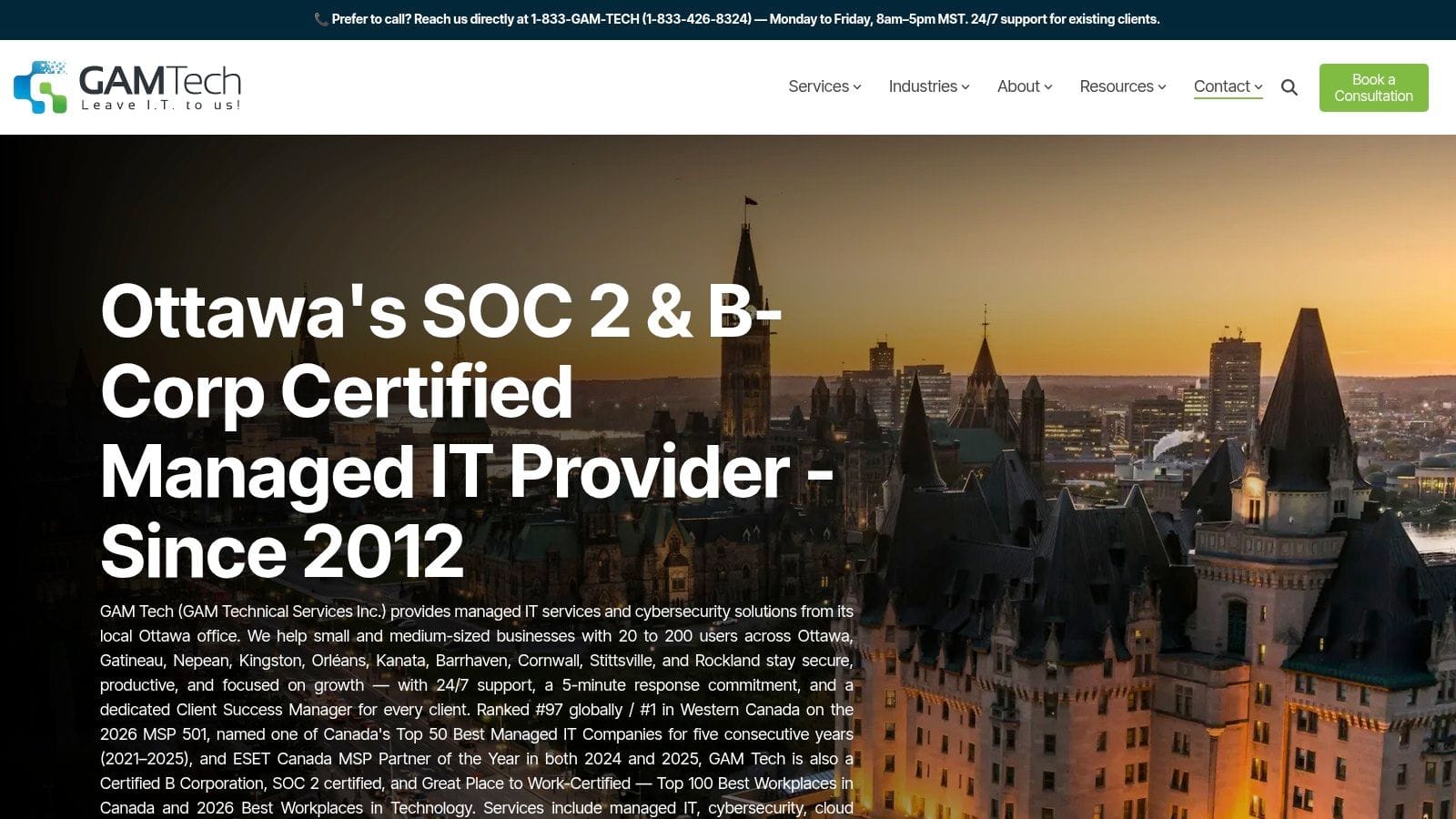
A common Ottawa buying scenario looks like this. The business has outgrown one or two go-to technicians, leadership wants tighter service standards, and a single-office support model no longer fits after-hours needs, cloud projects, or multiple locations. In that situation, GAM Tech Ottawa deserves a close look.
GAM Tech serves buyers who want local delivery with the backing of a larger MSP. That usually means better coverage across shifts, more consistent processes, and access to specialists for infrastructure, cloud, backup, and recovery work. The trade-off is familiar. As providers scale, relationship style often becomes more structured, and some smaller firms miss the highly personal feel they get from a boutique local partner.
Its publicly stated SOC 2 and B-Corp credentials give procurement teams and internal stakeholders a practical starting point. Those designations do not replace due diligence, but they do suggest that process, controls, and governance are part of the operating model rather than an afterthought.
This is a key decision test.
If your company needs a provider that can support growth without rebuilding the support model every year, ask GAM Tech how Ottawa delivery works day to day. Confirm who owns the relationship, which issues stay with the local team, which ones move to centralized resources, and how after-hours response is staffed. For multi-site firms, I would also ask how they keep onboarding, endpoint configuration, and backup standards consistent from one location to the next.
Commercial fit matters just as much as technical fit. GAM Tech does not publish pricing, so buyers should expect a sales-led scoping process and possible minimum engagement levels. Ask for a clear split between recurring support, strategic advisory work, and project billing. If that line stays blurry late into the conversation, budgeting will stay blurry after signing too.
Ottawa has a large, economically important technology sector, and many local businesses depend on stable systems, security discipline, and recoverable operations. That makes scale a real buying factor, not just a branding point. GAM Tech is a sensible option for organizations that want a more standardized service model, stronger bench depth, and visible operating controls. The right question is whether that structure matches how your business wants IT decisions, escalations, and accountability handled.
Ottawa Technology Companies, 7-Way Comparison
| Provider | 🔄 Implementation complexity | ⚡ Resource requirements | ⭐📊 Expected outcomes | 💡 Ideal use cases | Key advantages |
|---|---|---|---|---|---|
| IT Experts Canada | 🔄 Moderate, packaged end-to-end plans, structured migrations | ⚡ Low–Moderate, predictable per-user/device pricing, local & remote support | ⭐📊 Reduced downtime, proactive security monitoring, predictable IT costs | 💡 SMBs in Ottawa–Gatineau, regulated practices, multi-location businesses | Local bilingual support, 24/7 monitoring, telecom procurement, transparent pricing |
| Revolution Networks | 🔄 Moderate, combines help desk, projects and cabling | ⚡ Moderate, single partner for ops + infrastructure projects | ⭐📊 Centralized IT operations, smoother scaling and infrastructure builds | 💡 SMBs wanting one vendor for day-to-day IT and projects | Broad service catalog, local presence, cabling/infrastructure expertise |
| Bedrock IT | 🔄 Low–Moderate, focused managed services with 24/7 monitoring | ⚡ Low, SMB-oriented staffing and onsite responsiveness | ⭐📊 Improved uptime and faster incident response | 💡 Small teams prioritizing reliability and continuous monitoring | Emphasis on uptime, local responsiveness, Microsoft 365 support |
| Compulite | 🔄 Moderate–High, assessment-driven with formal processes | ⚡ Moderate, advisory team and in-house service desk | ⭐📊 Security-forward operations, mature processes for regulated clients | 💡 Public sector and SMBs needing structured IT governance | Longevity in market, security-first posture, local advisory capability |
| Stega Networks | 🔄 Moderate, infrastructure design plus managed IT services | ⚡ Moderate, network modernization and cabling resources | ⭐📊 Dependable operations during infrastructure upgrades | 💡 Organizations modernizing networks while keeping operations running | Blend of cabling/infrastructure and MSP services, planning & roadmapping |
| NCDS Canada Inc. | 🔄 Low, practical managed support and device standardization | ⚡ Low, SMB-focused tools and free initial assessments | ⭐📊 Practical day-to-day support, consistent device/user standards | 💡 Small businesses (10–100 employees) needing hands-on local support | SMB-tailored approach, free IT assessment, downtown Ottawa access |
| GAM Tech (Ottawa) | 🔄 Moderate, national processes applied to local practice, SOC2 | ⚡ Moderate–High, scalable teams, HaaS and compliance offerings | ⭐📊 Strong compliance posture, scalable coverage and project capacity | 💡 Compliance-minded SMBs, multi-site organizations, larger projects | SOC 2 & B‑Corp certifications, national scale, broad technical bench |
How to Choose Your Ideal Ottawa Tech Partner
Your controller wants predictable IT costs. Your operations lead wants fast support. Your insurer is asking harder questions about MFA, backups, and incident response. That mix is usually the buying scenario, and it is why choosing an Ottawa tech partner needs more than a shortlist of company names.
Use this decision as a structured evaluation, not a popularity contest. Start with two or three firms that look viable, then run the same set of questions through each meeting so you can compare answers side by side. From an Ottawa provider perspective, the strongest buying decisions usually come from consistency in the process, not from the best sales presentation.
Ask direct questions that expose how the provider works:
- Service delivery: Who answers after-hours calls, and is that team local, shared nationally, or outsourced?
- Onboarding: What does the first 30 to 90 days look like, and what work is billed separately?
- Security ownership: Who manages MFA, endpoint protection, patching, backups, and restore testing?
- Microsoft 365: Do they handle tenant administration, conditional access, licensing cleanup, and user offboarding?
- Escalation: What happens during a critical outage, and who has authority to make decisions?
- Commercial terms: What is included in the monthly agreement, and what triggers project or emergency billing?
Pricing deserves careful scrutiny, but not in isolation. Clutch can help you compare local providers and service positioning through its Ottawa IT services listings. The better question is whether the proposal explains what you are buying in plain language. If one quote is far lower than the others, check for gaps such as weak after-hours coverage, limited security ownership, or backup services that stop at monitoring and do not include restore testing.
Red flags tend to show up early. Vague answers on incident response. No clear line between managed services and project work. Heavy reliance on jargon when you ask who owns a failed backup, a compromised account, or a misconfigured Microsoft 365 policy.
Local fit matters too. Ottawa organizations often deal with bilingual teams, public sector expectations, hybrid work, and vendors that need onsite access on short notice. If your company handles regulated data or serves government-adjacent clients, ask for sample documentation, audit support practices, and a plain explanation of how incidents are recorded, escalated, and closed.
A simple decision lens helps keep the comparison grounded:
- Operational fit: Can they support your users, locations, and core systems without forcing workarounds?
- Security fit: Can they explain controls clearly and show who is accountable for each one?
- Commercial fit: Are pricing, exclusions, and change requests easy to understand before you sign?
- Relationship fit: Do they answer hard questions directly and communicate in business terms?
The right partner reduces risk, keeps support predictable, and gives leadership confidence that IT is being run with discipline. As noted earlier, IT Experts Canada is one of the Ottawa firms in this group. For buyers who want practical support, cybersecurity coverage, cloud guidance, and structured planning, they are worth including in the final comparison.
0 Comments