
It’s 8:17 on a Tuesday. Your team is in the office, a few people are remote, the phones are live, and then the Wi-Fi starts dropping. One file server is crawling. Microsoft 365 logins are lagging. Your clinic, law office, accounting firm, or growing service business can’t just “wait for IT” because the network is the business.
That’s where a lot of Ottawa and Gatineau owners are right now. They’re not asking for fancy infrastructure. They want staff to stay productive, client data to stay protected, and monthly IT costs to stop swinging wildly. They also know the risk has changed. In the Ottawa–Gatineau region, managed IT network services have become critical for small and mid-sized businesses because cyberattacks targeting Canadian organisations increased 43% between 2022 and 2024, with the National Capital Region seeing a disproportionate share of incidents, according to Clutch’s Ottawa MSP overview.
Table of Contents
- Is Your Network Helping or Hurting Your Business
- What Are Managed IT Network Services
- The Core Components of a Managed Network
- Key Business Benefits for Local SMBs
- Understanding Pricing and Service Models
- How to Choose Your Ottawa–Gatineau IT Partner
- Common Questions and Your Next Step
Is Your Network Helping or Hurting Your Business
A lot of owners don’t notice the network until it starts costing them money. A few dropped calls. Remote staff complaining about VPN access. Cloud apps freezing in the middle of client work. Then somebody clicks the wrong email, and suddenly the concern isn’t speed. It’s exposure.

In Ottawa, that pattern shows up in professional services firms, medical offices, construction companies, and multi-location businesses. The signs look ordinary at first. Staff restart devices. Someone power-cycles the modem. A manager postpones an update because “everything is working well enough.” Then the small issues pile up into lost hours, frustrated employees, and a business owner who’s paying for technology that doesn’t feel dependable.
The cost of waiting
The biggest mistake I see is treating network management like emergency plumbing. If something breaks, call someone. If nothing is visibly on fire, leave it alone. That approach worked when your office had a few desktops and one internet line. It doesn’t work when your operations depend on cloud apps, secure file access, video meetings, mobile devices, and compliance obligations on both sides of the river.
Your network isn’t back-office overhead anymore. It’s the delivery path for sales, service, records, communication, and trust.
Managed IT network services matter because they change the operating model. Instead of reacting to outages, you put monitoring, maintenance, security controls, and accountability in place before downtime hits. That’s the difference between losing half a day to a preventable issue and having the issue handled before your staff even notices.
What good management really changes
When a network is properly managed, your team stops improvising around recurring problems. People sign in, access what they need, print, call, collaborate, and move on with their day. That sounds basic. It’s also what most businesses want and too many don’t consistently get.
If your network creates friction every week, it’s hurting your business. If it supports work smoothly, securely, and predictably, it’s doing its job.
What Are Managed IT Network Services
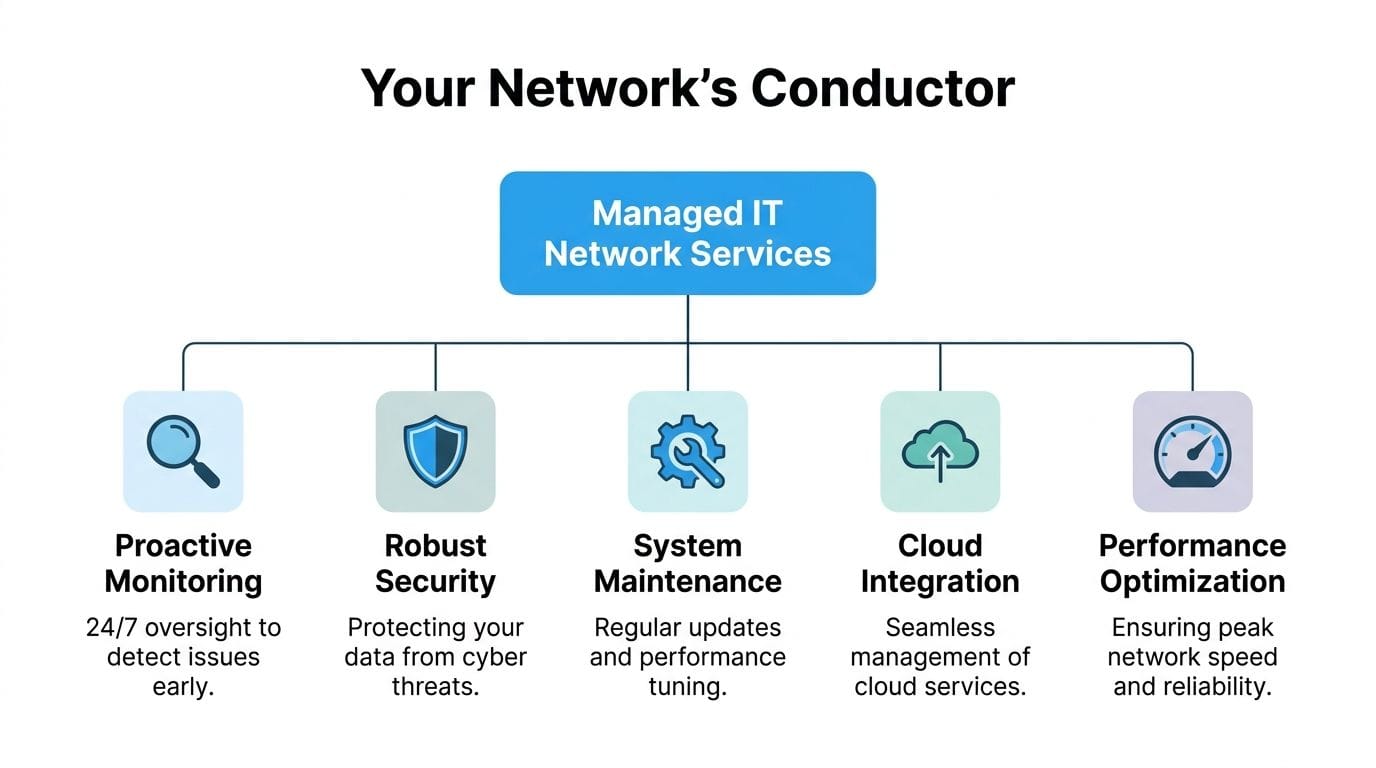
Managed IT network services give your business an outside team that runs, secures, and maintains the systems your staff depend on every day. That includes internet connectivity, Wi-Fi, firewalls, switches, user access, backups, patching, cloud admin, and support when something fails or slows down.
For an Ottawa or Gatineau business, that job goes beyond keeping people online. Your provider should support bilingual teams, coordinate across multiple offices or remote staff, and keep security controls aligned with obligations such as PHIPA and Law 25 when your network touches sensitive client, patient, or employee information.
What the service actually covers
A managed network service should include day-to-day ownership of the systems that keep work moving:
- Connectivity: internet circuits, office networking, switching, and wireless access
- Security: firewalls, endpoint protection, email filtering, and access controls
- Maintenance: updates, patching, device health checks, and licence oversight
- Continuity: backups, recovery planning, and restore testing
- Support: user issues, device setup, troubleshooting, and vendor coordination
That scope matters because small businesses rarely fail from one dramatic outage. They lose time through recurring friction. Weak Wi-Fi in the boardroom. A firewall rule nobody documented. A failed backup discovered too late. An employee locked out of Microsoft 365 during a client deadline.
What managed service changes
Managed service replaces informal IT habits with a defined operating model. Someone is watching the network, maintaining it on schedule, documenting changes, and responding under agreed service levels. If you want a clear example of the visibility and response process involved, review these systems and network monitoring services.
Practical rule: If your current IT arrangement cannot tell you what is being monitored, what is being patched, what is being backed up, and who responds after hours, you do not have managed service. You have a contact list.
That distinction matters even more in Ottawa–Gatineau. Many local firms deal with public sector clients, healthcare data, legal records, or cross-provincial privacy requirements. If your network is poorly managed, the risk is not limited to inconvenience. You can end up with missed work, failed audits, avoidable security exposure, and expensive cleanup.
A managed provider also handles adjacent services that affect network performance and control, including Microsoft 365 administration, identity management, device policies, and secure remote access. The goal is simple. Less downtime, tighter security, and predictable monthly costs without asking your office manager or operations lead to moonlight as network admin.
The Core Components of a Managed Network
A proper managed network isn’t one tool. It’s a stack of services that work together. If one layer is missing, problems slip through. If several are missing, you’re back to patchwork IT.
Monitoring that catches trouble early
Continuous monitoring is your early warning system. It watches servers, endpoints, internet connections, backup status, and critical services for issues that can turn into downtime. Good monitoring doesn’t just generate alerts. It triggers action.
That means someone is checking failed backups, unusual device behaviour, capacity issues, and recurring faults before users start filing complaints. If you want a practical example of what this looks like in the field, review systems and network monitoring services to see the kind of visibility and escalation workflow a managed setup should provide.
Here’s what matters operationally:
- Alert quality: noise is useless. Your provider should distinguish between routine events and genuine risk.
- Escalation discipline: somebody has to own the issue until it’s resolved, not just acknowledge the ticket.
- Documentation: recurring failures should lead to root-cause fixes, not endless resets.
Security controls that match local compliance reality
Security isn’t a separate project anymore. It’s part of network management. That matters even more in Ottawa–Gatineau, where many businesses handle regulated information, work with public sector clients, or operate across Ontario and Quebec requirements.
For businesses subject to Quebec’s Law 25 and Ontario’s PHIPA, managed network services that incorporate zero trust security and network segmentation achieve a 92% reduction in unauthorised access incidents within 12 months, according to GamTech’s Ottawa managed IT reference. That’s the business case for putting access control, layered defence, and monitoring into your network design instead of bolting them on later.
A serious security layer usually includes:
- Firewall management to control and inspect traffic
- Endpoint detection and response to watch devices for suspicious behaviour
- Email filtering to reduce phishing exposure
- Identity management so access follows the user’s role
- Segmentation to limit the damage if one device or user is compromised
If your accountant, receptionist, and external contractor all have broad access to the same systems, your problem isn’t convenience. It’s control.
Backups Wi-Fi and telecom that support daily operations
Backups are essential, but they’re only useful if they’re managed, tested, and tied to a recovery plan. Too many businesses think they have backup because files sync somewhere. That’s not the same as having restorable business data and a recovery path after ransomware, accidental deletion, or hardware failure.
Managed Wi-Fi also deserves more attention than it gets. Poor wireless design creates hidden costs. Slow roaming, dead zones, weak guest network separation, and insecure device access all affect daily work. In a small office, that becomes a morale problem. In a clinic or firm with confidential data, it becomes a governance problem too.
Telecom management rounds out the picture. Your provider should help with internet vendor coordination, failover planning, and business phone alignment, because the user doesn’t care whether the disruption came from your switch, ISP, or voice platform. They just know they can’t do their job.
Key Business Benefits for Local SMBs
An Ottawa clinic loses internet access at 9:10 a.m. Appointments back up, staff switch to personal hotspots, and nobody is sure whether the problem sits with the firewall, the ISP, or the phone system. In a law office or healthcare practice, that kind of outage is not just frustrating. It puts billable time, client trust, and compliance obligations at risk.

Less downtime and less internal friction
Small businesses feel network problems faster than larger firms because there is less slack in the day. If five people cannot access files, voice systems, or cloud apps, productivity drops immediately. Staff start creating workarounds, service slows down, and customer experience suffers.
Managed network services reduce those interruptions by bringing consistency to the environment. Systems get monitored, routine issues get handled before they spread, and support requests stop bouncing between random vendors. Your team stays focused on serving clients, not resetting devices or chasing internet tickets.
That matters even more in Ottawa–Gatineau, where many businesses need bilingual operations across offices, remote staff, and client-facing teams. If your network support cannot respond clearly in English and French, simple incidents take longer to resolve and internal confusion goes up.
Better security and stronger compliance discipline
Security is not just an IT concern. It is an operating requirement, especially for local practices and firms handling personal information, health data, employee records, or cross-border client communications. Ottawa businesses often need to align with PHIPA, Law 25, and client-driven security expectations at the same time.
A good provider brings structure to that work. Review the actual controls included in their security solutions for Ottawa businesses. You want monitored protection, controlled access, documented processes, and clear escalation when something suspicious happens.
One practical point often gets missed in buying conversations.
The primary win is control. You reduce preventable risk, respond to incidents faster, and make audits, client questionnaires, and policy reviews far less painful.
Predictable spending and clearer accountability
Unplanned IT costs frustrate owners because they usually arrive at the worst time. A failed switch, a rushed hardware replacement, or an emergency consultant invoice can blow up the month without fixing the underlying problem.
Managed services replace that pattern with defined scope, recurring costs, and one accountable partner. That gives local SMBs three business advantages:
- Easier budgeting. Monthly costs are easier to forecast than surprise repair bills.
- Cleaner ownership. You know who is responsible for support, vendor coordination, and follow-through.
- Better decisions. You can plan upgrades, risk reduction, and recovery priorities before a disruption forces the issue.
For Ottawa–Gatineau businesses, that accountability is especially valuable. Compliance questions, bilingual user support, internet provider issues, and business continuity planning often overlap. You need one partner who can handle the full operating picture, not a collection of disconnected providers.
Understanding Pricing and Service Models
Most business owners don’t mind paying for IT. They mind paying unpredictably, and they hate paying for a service they can’t compare properly. That’s why pricing structure matters almost as much as the technology itself.
The three models most Ottawa businesses will see
The first model is per-user pricing. This is usually the cleanest option for office-based businesses where each employee needs support across multiple devices and cloud tools. It aligns the monthly fee with headcount and usually makes budgeting straightforward.
The second is per-device pricing. This can fit environments with shared workstations, front-desk terminals, warehouse devices, or a mix of lightly used systems and specialist equipment. It can also become messy if your provider charges separately for every endpoint, server, firewall, and access point without giving you a clear total support picture.
The third is a tiered plan. These packages often bundle essentials at one level and add stronger security, backup, cloud administration, or compliance support at higher levels. Tiered plans can work well if the scope is clearly defined. They’re frustrating when the cheapest tier excludes the services you most need to stay stable.
According to a 2024 industry analysis of Canadian MSP pricing, the average monthly cost for managed network services in Ottawa ranges from $120 to $180 per user, depending on the included security, cloud, and backup services, as noted in 4it’s Ottawa managed IT pricing analysis.
Ontario MSPs also commonly use a flat-rate, unlimited support model with a fixed monthly fee, often structured per user, to cover proactive monitoring, patch management, and endpoint protection, as described in IT Experts Canada’s managed IT pricing guidance.
What a reasonable quote should include
A cheap quote is often incomplete. A useful quote spells out what you’re buying and what happens when things go wrong.
Look for these items in writing:
- Support scope: help desk channels, remote support, onsite support, and after-hours handling
- Security stack: endpoint protection, firewall management, email security, and identity controls
- Backup details: what’s protected, how often it’s checked, and whether restores are tested
- Cloud administration: Microsoft 365 or Google Workspace support, user management, and access changes
- Vendor coordination: whether the provider will deal with your ISP, telecom, and third-party software vendors
A fair price isn’t the lowest monthly number. It’s the quote that matches your operational risk without hiding essential services in change orders.
If you’re reviewing proposals, compare the service model first and the invoice second. Two quotes can look similar on paper while delivering very different outcomes once support, security, and backup accountability are tested in real life.
How to Choose Your Ottawa–Gatineau IT Partner
A managed service provider shouldn’t be chosen the same way you choose office supplies or internet bandwidth. This partner will touch your security, downtime response, user support, and compliance posture. Pick badly and you’ll inherit a steady stream of avoidable problems.

Start with response times local presence and language support
For local businesses, the first filter is simple. Can the provider support your business the way your business operates?
Local MSPs in Ottawa and Gatineau commonly commit to service-level agreements that include 99.9% guaranteed uptime and average response times of 15 minutes or less for critical incidents, which are standard benchmarks for managed network services in Canada, according to CloudSecureTech’s Ottawa managed services overview. If a provider can’t discuss SLA commitments clearly, move on.
If you operate in Gatineau or serve clients and staff across both provinces, language support also matters. You don’t want a critical issue delayed because a user can’t explain the problem comfortably or because service communication breaks down during an incident.
Provider Vetting Checklist
| Criteria | What to Look For |
|---|---|
| Local support model | Clear explanation of remote support, onsite coverage, and who handles urgent incidents in Ottawa–Gatineau |
| SLA commitments | Written uptime commitments, response targets for critical issues, and escalation steps |
| Security capability | Managed firewall, endpoint protection, email filtering, access controls, and ongoing monitoring |
| Backup discipline | Verified backups, restore testing, and a defined recovery process |
| Microsoft 365 and cloud support | User administration, licence management, identity controls, and migration support |
| Bilingual service | English and Canadian French support for users, documentation, and incident handling where needed |
| Vendor management | Willingness to coordinate with telecom carriers, software vendors, and cloud providers |
| Reporting and review process | Regular service reviews, asset visibility, and practical recommendations instead of vague status notes |
Questions worth asking before you sign
Don’t ask broad questions like “Are you proactive?” Every provider says yes. Ask questions that force a specific answer.
- Who answers after hours? You want a real support path, not a voicemail promise.
- What’s included in monitoring? Devices, backups, cloud services, firewalls, and user-impacting alerts should all be addressed.
- How do you handle onboarding? A sloppy transition creates months of cleanup.
- What does onsite support look like? Some issues can’t be solved well through a remote-only model.
- How do you support Gatineau users? Bilingual coverage should be operational, not just marketing copy.
The right provider should make your environment more organised within the first few months. If their process sounds vague at the start, it won’t become clearer after you sign.
Common Questions and Your Next Step
A few objections come up repeatedly.
Will you lose control of your systems? No. A good managed provider improves visibility, standardises administration, and gives you clearer reporting. You should have more control, not less.
Is your business too small? Usually not. Smaller organisations often benefit the most because they feel downtime and security issues more sharply and rarely have internal bandwidth to manage them well.
What if your team is split between Ottawa and Gatineau? Then support has to reflect that reality. Bilingual managed IT support is a critical operational requirement in Gatineau, where providers need to deliver fast, localised service across federal offices and professional communities to support compliance and effective incident handling, as described on Cloud Collective’s Gatineau IT services page.
The next sensible move isn’t to buy blindly. It’s to get your current setup reviewed, identify the weak points, and compare that against a managed support model that fits your size, risk, and budget.
If your network feels fragile, expensive, or harder to manage than it should be, talk to IT Experts Canada for a complimentary initial analysis. It’s a practical way to review your current environment, spot support gaps, and decide whether a managed service model makes business sense for your Ottawa or Gatineau operation.
0 Comments