
You can run a strong business in Ottawa and still feel one bad network morning away from chaos. The phones ring late, staff can't open shared files, a cloud login stalls in both English and French, and a client wants an answer before lunch. In this market, Ottawa IT support is not a background utility, it's the difference between a clean workday and a long, expensive reset.
Local support matters here because Ottawa is not a generic office market. It's a bilingual, cross-provincial business environment with a deep technology base, a cybersecurity-heavy ecosystem, and service expectations shaped by government, regulated industries, and regional talent movement. If you're choosing an IT partner in Ottawa, you need more than someone who can “fix computers”. You need someone who can keep operations steady, support users who aren't technical, and handle security and continuity without creating more work for your team.
Table of Contents
- Introduction to Ottawa IT Support
- Understanding Key Concepts
- Core Services Offered
- Benefits for SMBs and Regulated Sectors
- How to Evaluate and Choose a Provider
- Pricing Models and Cost Drivers
- Case Examples and Testimonials
- Conclusion and Next Steps
Introduction to Ottawa IT Support
A typical Ottawa owner doesn't notice IT until it slips. One day the office is humming, staff are in Microsoft 365, phones are routing correctly, and remote users are getting through without trouble. Then a switch fails, a laptop falls behind on patches, or a cloud app becomes the bottleneck, and the whole team starts losing time.
That's why local support has to be practical, not theatrical. In Ottawa, the right provider needs to understand bilingual service expectations, the Ontario and Québec side of the market, and the operational reality of small teams that can't afford long outages. The best support model protects productivity first, then security, then budget.
For SMBs and regulated sectors, the stakes are bigger than inconvenience. Lost access to files, delayed client service, and weak recovery plans all turn into avoidable cost. Ottawa businesses need support that is built for continuity, not just break-fix relief.
Understanding Key Concepts
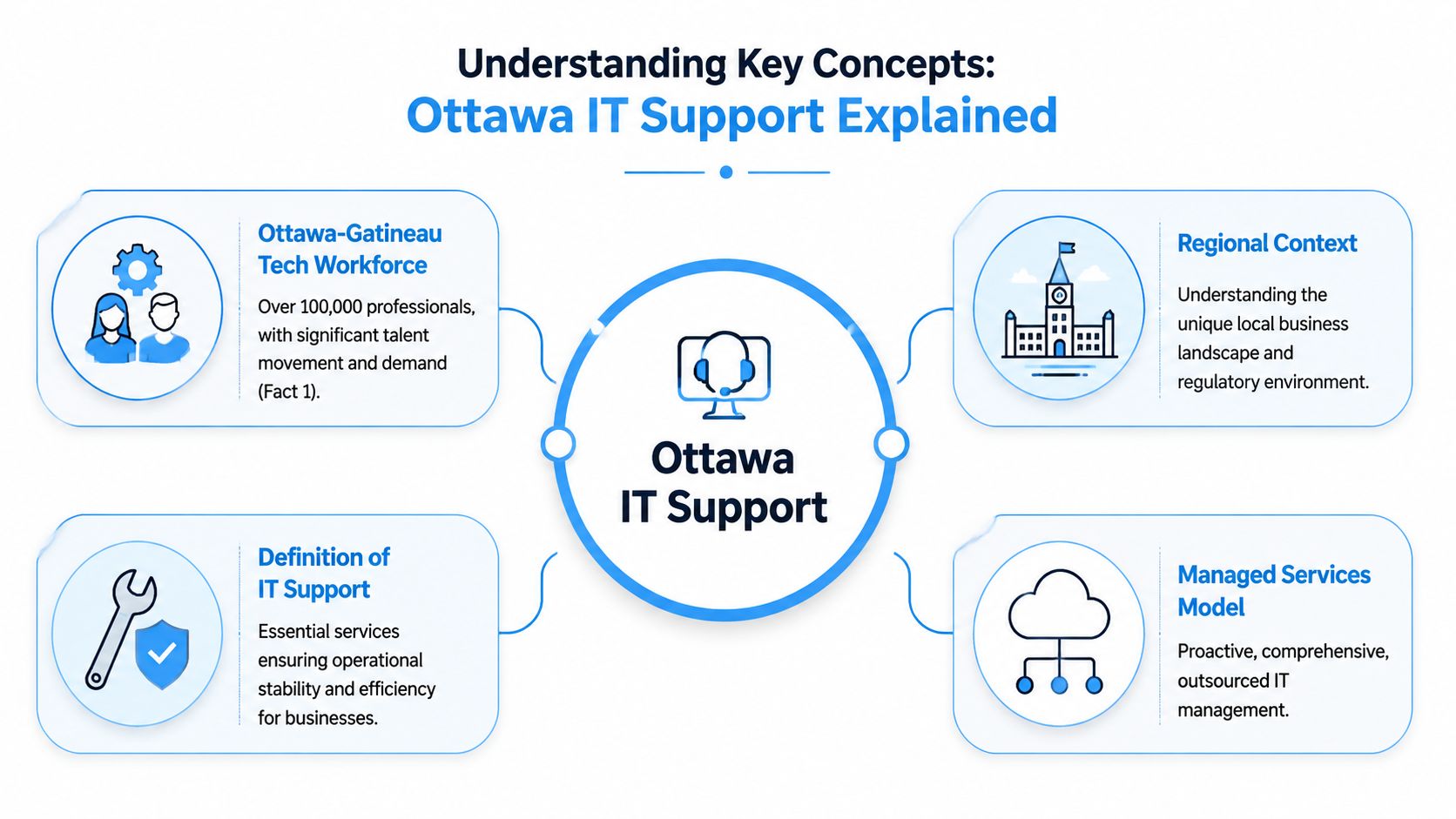
A small Ottawa business feels the difference fast. One support provider answers phones and clears tickets. Another keeps your systems monitored, patched, recoverable, and ready for bilingual staff across Ottawa and Gatineau. That second model is what Ottawa IT support should mean in practice.
The region makes that distinction matter. Ottawa sits inside a dense technology labour market and a cybersecurity-heavy economy, so support vendors are judged on more than quick fixes. Staffing depth, service continuity, and local knowledge all affect how fast problems get handled when someone is out sick, a project is in crunch mode, or an incident hits after hours.
The local ecosystem shapes the service standard
Ottawa's tech base is broad, spanning software, telecommunications, aerospace and defence, cybersecurity, and semiconductors, according to Invest Ottawa. That mix pushes local buyers to expect more from providers, especially around managed services, cloud support, and security. Providers that work in this market every day are more likely to understand the pressure points that come with regulated clients, hybrid teams, and infrastructure that has to stay up without drama.
The cyber side of the region raises expectations further. A 2025 Why Ottawa sector fact sheet describes Ottawa-Gatineau as “Canada's Cyber Cluster” and says it includes cybersecurity services, encryption, identity and access management, risk and compliance, security operations, vulnerability defence, and ancillary services (Why Ottawa cybersecurity fact sheet). For local buyers, that means layered security, monitoring, and compliance-aware support should be standard. It also explains why bilingual delivery and cross-provincial experience matter, especially for firms that serve clients on both sides of the Ottawa River.
Practical rule: If a provider talks only about fixing tickets, they are behind the market. In Ottawa, support has to cover operations, security, recovery, and user readiness together.
What the term should mean in practice
At a minimum, IT support should include monitoring, incident response, patching, recovery planning, and end-user support. Break-fix reacts after something hurts the business. Managed support is built to stop that pain from reaching users in the first place. That difference is why local outsourcing makes sense for SMEs that need specialist capability without carrying the overhead of a large in-house team.
The regional cyber cluster also lines up with federal digital change around Ottawa. The Cyber Cluster context, plus federal cloud and security priorities, pushes expectations upward for local providers and the businesses that hire them. That affects procurement, talent availability, and the baseline for what owners should demand from a support partner. For Ottawa businesses, the takeaway is simple. Choose support that protects operations, keeps users productive, and matches the bilingual market they serve.
Core Services Offered
The strongest Ottawa providers organize their work around a few core service pillars, and they do it without creating more noise for your team. Good support should feel boring in the best possible way, because boring means systems are being watched, patched, backed up, and kept ready before users get stuck.
Helpdesk, monitoring, and the day-to-day rescue work
Remote and onsite helpdesk support is the front door. It covers user issues, device problems, account access, printer annoyances, and the practical interruptions that slow work down. In Ottawa, bilingual support matters because the service experience has to match the market, not just the software stack.
Managed networking and endpoint monitoring sit behind the helpdesk. They keep watch on communication networks and connected hardware so problems get flagged early, capacity is tracked, and traffic can be tuned before users feel the strain. Patch management, updates, recovery planning, and server or network auditing belong in the same operating model, because each one reduces the chance that a small issue turns into a business interruption.
Short version: If your support plan does not include telemetry, patch governance, and recovery procedures, it is incomplete.
Security, cloud, and continuity
Cybersecurity should be layered. In Ottawa's cyber ecosystem, that means endpoint protection, threat monitoring, firewall management, and oversight that fits how regulated businesses work. If you want a practical starting point, review a provider's security solutions for Ottawa businesses and check whether it ties protection, response, and user training together instead of treating them as separate chores. Cloud enablement should cover Microsoft 365, Google Workspace, hosted desktops, and backup services, because migration without support just moves the pain into a new environment.
Data backup and disaster recovery are not side services. They separate a short interruption from a damaging outage. Voice and data telecom support matters too, because many Ottawa SMBs are still dealing with internet, phone, and vendor coordination at the same time. If your IT partner cannot help manage those moving parts, you are still left doing the orchestration yourself.
The diagram above shows how these service layers fit together, with support, security, cloud, and communications working as one operating model. That matters in Ottawa because businesses here often need one team that can handle English and French support, cross-provincial coordination, and the basic training that helps staff use new systems properly. Providers who structure their services around managed IT, cloud, cybersecurity, and telecom support are aiming at proactive monitoring and prevention, not just ticket handling.
This video gives a quick look at the kind of managed service structure Ottawa buyers should expect. It is useful because it shows how support, security, and continuity belong in the same conversation, not in separate buying decisions.
Why the service mix matters
Ottawa businesses often underestimate how much risk comes from disconnected support. One vendor handles internet, another handles devices, another handles email, and nobody owns the whole chain. Delay creeps in quickly.
The better model is integrated. Monitoring, cloud administration, cybersecurity, backups, telecom, and escalation paths should sit under one operating framework. In this region, that also includes training and digital inclusion services, because users only benefit from technology they can adopt. Ottawa-Gatineau firms, especially those serving clients on both sides of the river, need support that matches the bilingual market and keeps the whole environment moving without confusion.
Benefits for SMBs and Regulated Sectors
Ottawa small businesses do not buy managed IT because it sounds modern. They buy it because one outage can stop billing, delay client work, and pull staff away from their real jobs. In a city that spans Ottawa and Gatineau, with bilingual teams and cross-provincial workflows, the wrong support model creates more friction than most owners expect.
Less downtime, better control
Strong Ottawa IT support focuses on continuous monitoring of endpoints, networks, and cloud services, so problems are caught before users feel them. That gives owners something they can actually use, fewer surprise disruptions and less time spent chasing issues after the fact.
The local advantage matters here. A provider that understands both English and French support, and the way Ottawa-Gatineau businesses move across the Ontario-Québec line, can keep service requests, escalation, and user training aligned instead of scattered. That matters because staff adopt tools faster when support is clear, bilingual, and practical.
Compliance, continuity, and budgeting
Regulated sectors need more than basic troubleshooting. Healthcare, legal, accounting, and finance firms need disciplined access control, patching, logging, and recovery habits that hold up when someone asks for proof. A provider that treats security solutions as part of daily operations, not a side project, gives you a better footing for audits and internal reviews.
This also helps with continuity. When backups, incident response, and restore steps are documented and tested, your team is not guessing during a disruption. That reduces confusion, keeps decisions faster, and makes it easier to show clients or regulators that the business has a real recovery process.
Budgeting improves too. Managed support shifts spending away from emergency fixes and last-minute vendor calls toward planned coverage, planned maintenance, and planned recovery. That is the kind of spending pattern small business owners can manage without getting hit by avoidable surprises.
Bottom line: SMBs do not buy managed IT because they want another vendor. They buy it because downtime, weak recovery, and sloppy security cost more than steady, disciplined support.
The scale benefit is just as important. As a company adds users, devices, office locations, or cloud tools, a managed model can grow with it without forcing the owner to become the dispatcher. In Ottawa's bilingual, cross-provincial market, that also means the provider should be ready to support staff training and digital inclusion, so the whole team can use the systems it depends on.
How to Evaluate and Choose a Provider
Choose an Ottawa provider the same way you'd choose a key operations partner, by checking how they handle pressure, language, and follow-through. Don't start with sales language. Start with service mechanics.
Use a hard checklist
- Bilingual delivery: Ask who answers calls, who writes tickets, and who handles escalation in both English and French. In Ottawa, bilingual support is part of the service standard, not a nice extra.
- Local response discipline: Statistics Canada's Ottawa-based support services benchmark weekday core assistance at 8:30 a.m. to 4:30 p.m. ET, which is a useful reference point for local operating hours (Statistics Canada reference centre). If your business runs outside that window, ask how critical incidents are handled after hours.
- Monitoring depth: Ask what they monitor; endpoints, servers, network health, cloud services, and backup status should all be on the table.
- Recovery proof: Request their backup testing and disaster recovery approach. If they can't describe restore steps clearly, the plan is too vague.
- Compliance fit: For regulated firms, ask how they handle documentation, access controls, and incident traceability.
- Cultural fit: Your provider should understand how your staff works, not just what software you own.
Ask about process, not promises
Service-level agreements matter, but only if they match the way your business operates. Ask what's included, what's excluded, and what triggers escalation. A provider that publishes pricing guidance is usually easier to compare because they've already thought through scope and cost drivers.
Use IT Experts Canada's managed IT services page as one reference point when you're comparing support models, then measure every other proposal against the same checklist. The goal is not to find the cheapest option. The goal is to find the provider that can keep your operations steady without making your staff chase answers.
Practical rule: If a provider can't explain how they detect, escalate, and recover from common issues, keep looking.
Pricing Models and Cost Drivers
Ottawa MSP pricing usually follows a few patterns, and you should understand them before you buy. The model matters because it determines what the provider can absorb, what gets billed separately, and where your costs might climb as your business grows.
Common MSP pricing models
| Model | Description | Typical Cost Drivers |
|---|---|---|
| Per-user | A fee tied to each supported employee | Number of users, support scope, security stack, cloud services |
| Per-device | A fee tied to each laptop, desktop, server, or endpoint | Endpoint count, device mix, patching load, monitoring scope |
| Hybrid tier | A mix of per-user and per-device pricing with bundled services | Network complexity, cloud consumption, backup needs, 24/7 coverage |
| Service bundle | A fixed package with defined inclusions and add-ons | Onsite frequency, telecom support, recovery services, after-hours response |
What actually pushes the price
Cost drivers are usually operational, not mysterious. More endpoints take more monitoring and patching. More sites mean more network management. More cloud services create more administration and more support calls. If your environment requires after-hours monitoring, that should be priced explicitly because someone has to watch the system when the office is closed.
Telecom can also affect spend. Businesses often carry old phone plans, duplicate internet services, or disconnected vendor contracts that inflate monthly overhead. A provider that handles voice and data can usually clean up that mess by aligning services to actual use instead of historical habit.
A pricing page should make this easier, not harder. Review IT Experts Canada's pricing guidance and compare it to the scope you need, not the scope you hope you might need one day. If the proposal doesn't explain what drives the number up or down, you don't really have a pricing model yet.
How to think about budget fit
Don't shop for the lowest monthly fee in isolation. A cheap plan that excludes monitoring, recovery, or after-hours escalation can become expensive the first time something goes wrong. A better question is whether the plan matches your risk profile and the way your team works.
For Ottawa SMBs, the right price is the one that handles the work you don't want your staff doing manually. That includes patch follow-up, device oversight, vendor coordination, and restoring access quickly when something breaks.
Case Examples and Testimonials
Ottawa owners do not judge support by brochure language. They judge it by whether the office stayed open, whether staff kept working, and whether problems got handled without dragging everyone into technical details.
Three local patterns that keep showing up
A dental clinic in the region needed stable systems, disciplined reporting, and less disruption from day to day. The result they wanted was straightforward, no visible downtime for patients and fewer surprises behind the scenes. In a regulated setting, good support should deliver calm operations, clear follow-through, and fast recovery when something slips.
A retail franchise faced a different issue. Telecom spend and cloud point-of-sale changes were making operations harder to manage. The right support model in that case coordinates connectivity, cloud migration, and vendor management so the owner is not bouncing between phone bills, store managers, and software vendors.
A law firm serving Ottawa and Gatineau had a training problem tied to a secure software rollout. The system itself was only part of the job. Administrative staff needed coaching on how to use it correctly, and the firm needed support that worked in both English and French so adoption did not stall between offices. That is where local bilingual support matters, especially in a cross-provincial market where one team may work out of Ottawa while another handles files and clients on the Gatineau side.
A nonprofit serving low-income staff had a different kind of need, because access alone was not enough. The organization needed training-led support, not just infrastructure help. That lines up with Ottawa's digital inclusion work, where people still need someone to guide them after the device is installed and the software is live. Recent Ottawa-area support activity around seniors and digital inclusion shows demand for ongoing coaching alongside technical setup (Connected Canadians support listing).
What that means for buyers
Local demand is rising for support that includes teaching, onboarding, and adoption help, especially where users are not technical or where older adults are part of the service audience. That is not a side issue. It exposes a real gap in how many businesses think about IT. They buy tools and forget the human layer.
Direct advice: If your staff still needs coaching after deployment, treat that as part of IT support, not as an informal favour.
I would rather see a provider that can solve user confusion, train staff, and keep systems stable than one that only appears after something breaks. That is the difference between support that creates momentum and support that just clears tickets.
Conclusion and Next Steps
Ottawa buyers should stop thinking about IT support as a single service. In this region, it's a mix of monitoring, cybersecurity, cloud administration, telecom coordination, recovery planning, and user enablement. The best providers understand the bilingual, cross-provincial, cyber-heavy market they're serving, and they build for continuity instead of interruption.
That matters because Ottawa businesses don't operate in a vacuum. They sit inside a labour market with noticeable ICT volatility, a cybersecurity cluster that raises expectations, and a public-interest digital ecosystem that keeps reminding everyone that support is as much about people as infrastructure. If your current arrangement leaves you guessing about escalation, backups, or who helps non-technical staff after deployment, you're carrying too much risk yourself.
Start with a frank infrastructure review. Ask for a complimentary initial analysis, compare published pricing, and push for a discovery call that tests how the provider handles bilingual support, monitoring depth, and recovery planning. If the answers are vague, keep moving. If they're precise, you've probably found a partner worth talking to.
A CTA for IT Experts Canada.
0 Comments